Happy Easter
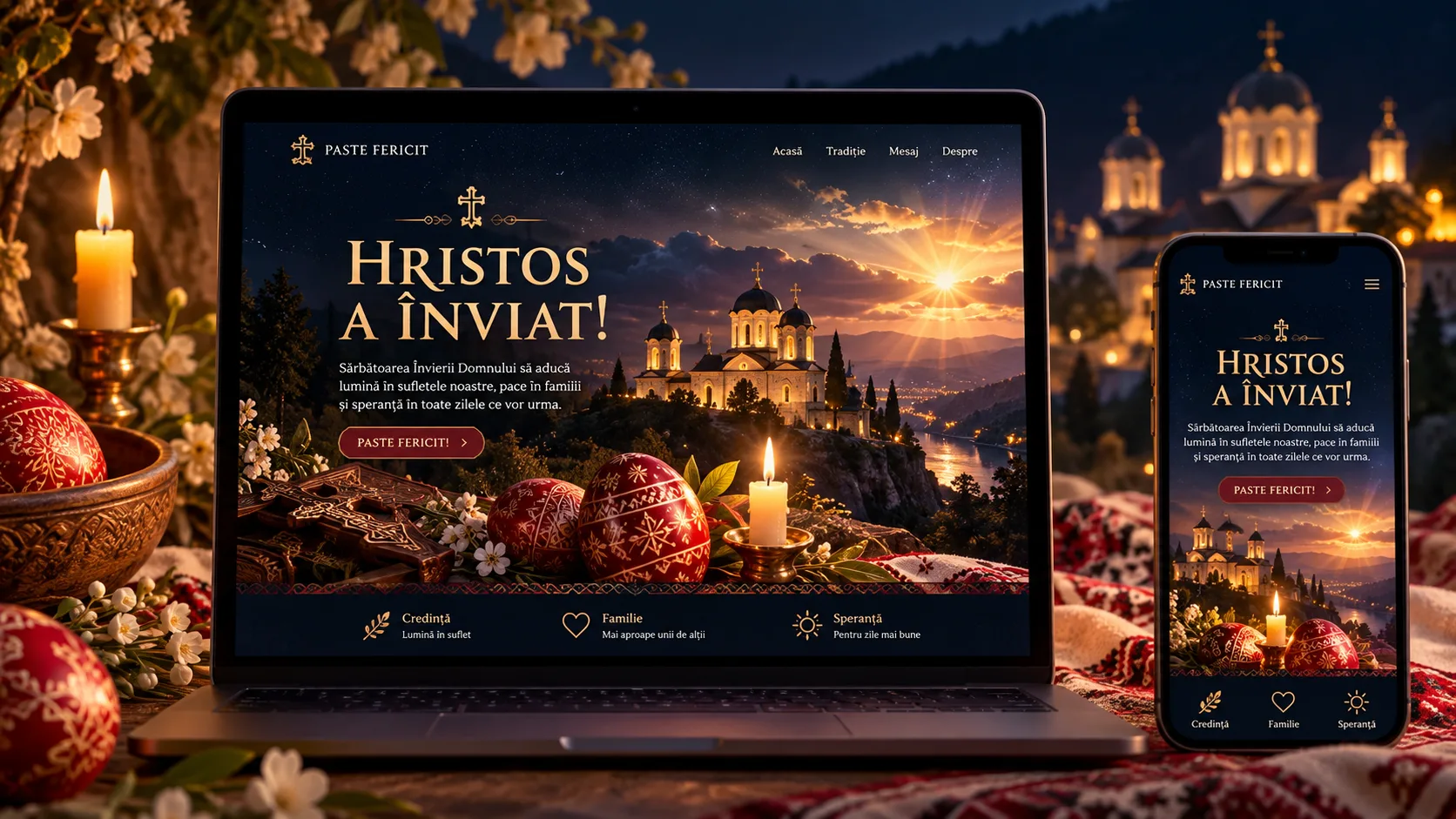
Easter landing page concept with a visual direction inspired by the night of the Resurrection: Byzantine gold, liturgical burgundy, ceremonial typography, Orthodox symbols, and subtle animations, designed for a fast, accessible static experience.
Core stack
The challenge
The challenge was defining a holiday page that conveys the specific character of Romanian Orthodox Easter without falling into a generic template with Western pastels and symbols, while keeping performance, mobile readability, accessibility, and an implementation simple enough for static hosting.
The solution
The documented solution starts from a coherent visual direction and a static architecture. The design brief establishes the palette, typography, four-section layout, iconography, and animations, and the technical decision chooses Astro + Tailwind CSS for SSG and a minimal bundle. All effects are designed to work without complex state or a backend and to degrade gracefully for users with reduced motion.
Notable complexity
Paste Fericit is a personal study for a seasonal web experience dedicated to Romanian Orthodox Easter. The verified repository does not contain the final application on the main branch; however, it contains a detailed design brief, the technical decisions, and the work history that describe the intended product very clearly. For this reason, the project is presented as a documented concept/prototype, not as a finished site or a launched product.
The product direction avoids the generic Western Easter aesthetic and builds the experience around the moment of midnight: blue-black and burgundy background, gold inspired by icons, candlelight, a three-bar Orthodox cross, a red egg with Romanian geometric motifs, and subtle floral elements. The page was designed as a continuous vertical scroll with four zones: fullscreen hero, greeting message, decorative section, and minimal footer.
The documented design system defines tokens for colors, typography, spacing, shadows, transitions, and breakpoints. The proposed fonts are Cinzel Decorative for the monumental messages, Cinzel for subheadings, and Cormorant Garamond for body text. The brief includes a mobile-first approach, a narrow container for readability, and different typographic scales for phone, tablet, and desktop.
The planned interactions are deliberate and lightweight: candle glow, golden particles, heading reveal, subtle shimmer, and scroll-triggered appearances via IntersectionObserver. The documentation explicitly requires respecting prefers-reduced-motion and avoiding aggressive animations, autoplaying audio, and effects that would distract from the message.
The chosen architecture evolved from a Vanilla Vite scaffold to Astro + Tailwind CSS, for static generation and minimal JavaScript shipped to the browser. The history mentions the temporary existence of a Vite scaffold and some CSS/JS files, but these are not present in the current commit, so they are not treated as delivered implementation.
Deployment was planned for Hetzner: a static build in dist/ and copying to the server for paste.tigidal.ro. However, the repository contains no CI/CD workflow, deploy script, Nginx configuration, build output, or commit demonstrating actual publication. The URL is not used as a public link in the portfolio since it could not be verified as an available site at the time of analysis.
Key results
- Complete design brief for the 'Night of Resurrection' experience, with palette, typography, spacing, shadows, breakpoints, and usage rules
- Page architecture documented in four sections: hero, greeting, decorative zone, and footer
- Visual direction based on Romanian Orthodox symbols and explicit rules for avoiding a generic Western aesthetic
- Lightweight animation plan for glow, particles, text reveal, shimmer, and scroll-triggered appearances
- Accessibility requirement for prefers-reduced-motion and minimum contrast documented in the design brief
- Architecture decision for Astro + Tailwind CSS and static generation
- Static deployment plan on Hetzner, with no dedicated backend
- Documented separation between the initial, later abandoned Vite scaffold and the Astro stack chosen for the final implementation
Related projects
- CarFix Paint SiteReact website for an auto repair shop in Brașov, with dedicated pages for services and RCA/CASCO insurance claims, a before/after portfolio, blog, FAQ, reviews, contact forms, and local SEO infrastructure.
- Flower PowerPremium digital presence for a flower shop in the Brașov area: a responsive site with a floral portfolio, services, blog, giveaways, and full administration through Payload CMS integrated directly into Next.js.
- Tigidal ChristmasSeasonal web experience in Remix, with a Christmas message personalized from the route, a layered parallax scene, canvas-animated snowfall, a countdown, and responsive assets for desktop and mobile.
Want something similar?
Start with the estimate wizard — answer a few questions and get a realistic price range and timeline.