Flower Power
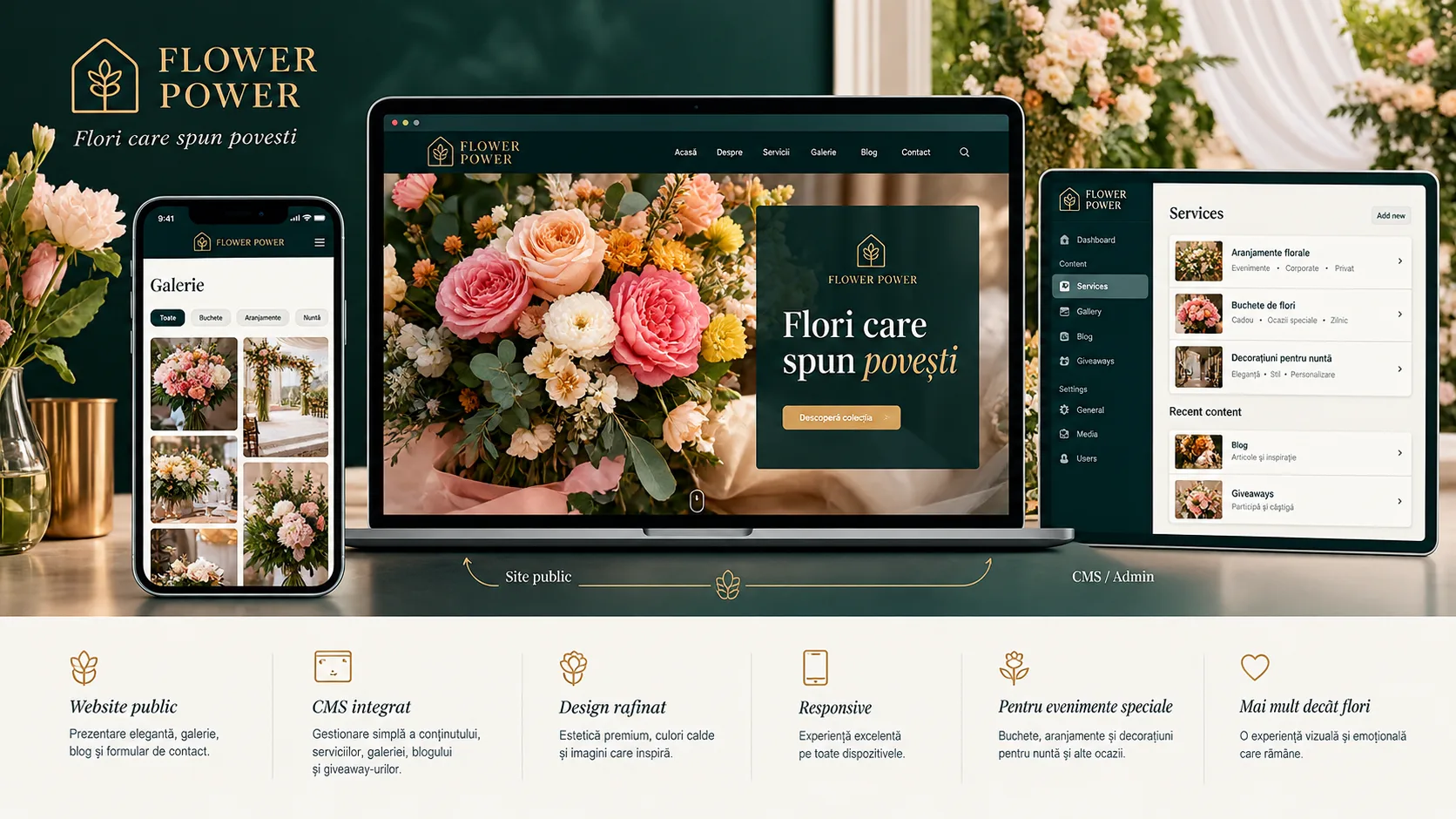
Premium digital presence for a flower shop in the Brașov area: a responsive site with a floral portfolio, services, blog, giveaways, and full administration through Payload CMS integrated directly into Next.js.
Core stack
The challenge
The challenge was turning a visual website for a flower shop into a manageable application without a separate backend: content had to remain SEO-friendly and server-rendered, the image-rich gallery had to keep a premium experience on mobile, and the forms and giveaways needed real validation and persistence flows without loading the frontend with infrastructure logic.
The solution
The application was structured as a Next.js + Payload CMS monolith: the App Router for the site and APIs, the Payload Local API for server-side content, collections and globals for administration, SQLite as the adapter configured in the repository, Resend for contact, and isolated client components for interactions. The custom design, optimized images, gallery filtering, lightbox, metadata/JSON-LD, and a Playwright suite complete the public surface and the editorial flows.
Notable complexity
Flower Power is a project for a real client, built as a monolithic Next.js application where the public site, the Payload CMS admin panel, and the APIs all run in the same codebase. The product's purpose is to visually showcase floral creations and turn content that would otherwise be edited manually into a manageable flow: services, gallery, articles, giveaways, hero, and the flower shop's general information.
The frontend uses the App Router and separates the public surface from the Payload routes. Important content is loaded server-side through the Payload Local API, and interactive components remain client-side only where needed: the hero carousel, the mobile menu, gallery filtering, the lightbox, and the forms. The design has its own visual system based on dark petrol green, gold accents, and a cream background, with Playfair Display for headings, Inter for body text, and Cormorant Garamond for editorial accents. The full-screen hero combines real images, fade transitions, and a Ken Burns effect, and respects prefers-reduced-motion.
Payload CMS manages admin users, media, blog posts, services, the gallery, giveaways and their entries, plus globals for site settings, the hero, and the About page. Media can be read publicly for rendering the site, while giveaway entries are visible and editable only to authenticated CMS users. The public gallery is organized by category and uses a masonry grid with a lightbox; the repository includes a curated set of real photos for bouquets, arrangements, weddings and christenings, decorations, gifts, and seasonal collections.
The giveaway flow is one of the few flows with operational persistence: the public page sends the name, email, and phone to a Next.js endpoint, which resolves the giveaway by slug, checks whether the same email address is already entered in the same campaign, and persists the entry in Payload along with the timestamp and IP reported by the infrastructure. Duplication is prevented at the application level by checking before create, but there is no unique database constraint or locking, so the implementation does not claim strict idempotency under concurrency.
The contact form validates required fields and the email format and can send messages via Resend to the address configured in the CMS. Email sending is intentionally non-blocking for the API response: if the provider is not configured or sending fails, the error is logged and the endpoint still responds with success. The code does not persist contact messages and includes no rate limiting, CAPTCHA, or retry queue, aspects that should be hardened before high public traffic.
SEO is handled at the application level through per-page metadata, canonical URLs, a dynamic sitemap for blog and giveaways, robots, and JSON-LD for the florist and articles. There is also a health endpoint. The Playwright suite covers navigation, forms, and the mobile experience, but some assertions and slugs in the tests have fallen behind the latest UI/CMS changes, so the presence of tests is not presented as proof that the current build is green.
From a security perspective, the application sets headers such as X-Frame-Options, X-Content-Type-Options, Referrer-Policy, and Permissions-Policy, and protects reading/modifying CMS entries through authentication. At the same time, the configuration has a hardcoded fallback for PAYLOAD_SECRET, SQLite is the default fallback, public endpoints have no rate limiting, and personal data from forms needs an explicit retention and logging policy for production. These are limitations identified from the code, not features masked in the project's presentation.
The Git history shows that the repository started from the create-next-app boilerplate, then received the custom pages and design, SEO and real images, the forms, the contrast and responsive audit, the E2E tests, the cinematic carousel, and finally the Payload/Resend integration. Sanity dependencies and files remain as residue from an earlier stage, while the current content paths use Payload. The project is therefore closer to an operational website with a CMS and campaigns than to a simple CRUD or an e-commerce store.
Key results
- Responsive public site with dedicated pages for home, services, gallery, about, contact, blog, and giveaways
- Payload CMS panel and API integrated into the same Next.js application, with no separate backend
- CMS collections for media, services, gallery, blog, giveaways, and entries, plus globals for the hero, settings, and About page
- Categorized gallery with a masonry layout, query-parameter filtering, and lightbox
- CMS-configurable full-screen hero, with local fallback, autoplay, fade, Ken Burns, and respect for prefers-reduced-motion
- Dynamic blog with Lexical rich text, individual pages, metadata, and BlogPosting structured data
- Giveaway flow with server-side validation, entry persistence, and anti-duplication check on email + campaign
- Restricted access for reading, updating, and deleting giveaway entries in Payload
- Contact form optionally connected to Resend and configurable through CMS data
- Technical SEO with canonical metadata, dynamic sitemap, robots, and LocalBusiness JSON-LD
- Security HTTP headers configured at the Next.js level and a health-check endpoint
- Playwright E2E tests for navigation, forms, and the mobile experience, with a few assertions still to be synced with the current UI
Related projects
- CarFix Paint SiteReact website for an auto repair shop in Brașov, with dedicated pages for services and RCA/CASCO insurance claims, a before/after portfolio, blog, FAQ, reviews, contact forms, and local SEO infrastructure.
- Happy EasterEaster landing page concept with a visual direction inspired by the night of the Resurrection: Byzantine gold, liturgical burgundy, ceremonial typography, Orthodox symbols, and subtle animations, designed for a fast, accessible static experience.
- Tigidal ChristmasSeasonal web experience in Remix, with a Christmas message personalized from the route, a layered parallax scene, canvas-animated snowfall, a countdown, and responsive assets for desktop and mobile.
Want something similar?
Start with the estimate wizard — answer a few questions and get a realistic price range and timeline.