CarFix Paint Site
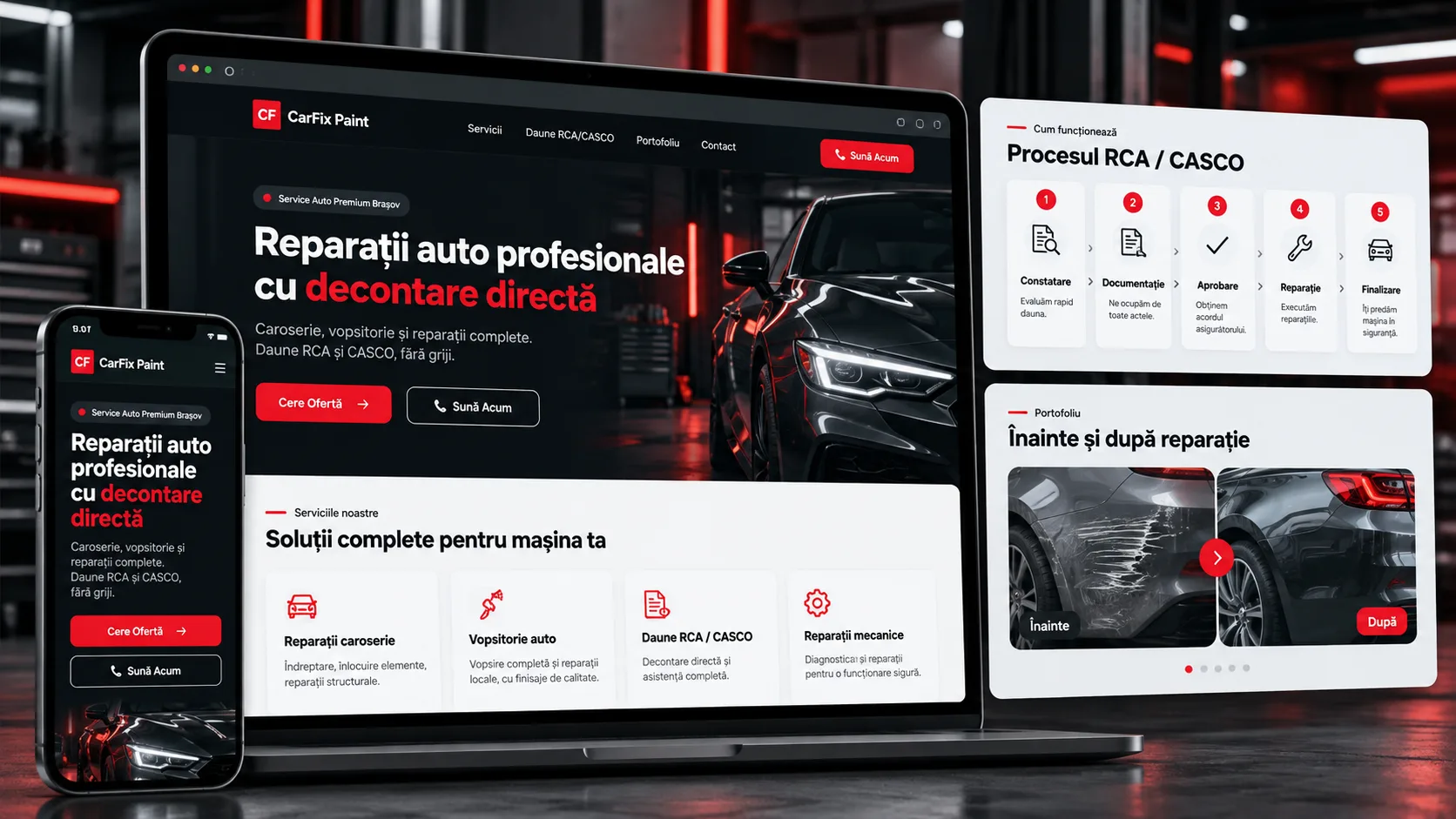
React website for an auto repair shop in Brașov, with dedicated pages for services and RCA/CASCO insurance claims, a before/after portfolio, blog, FAQ, reviews, contact forms, and local SEO infrastructure.
Core stack
The challenge
The challenge was structuring a local auto-shop site so that technical services and a difficult client process — particularly RCA/CASCO insurance claims — could be understood quickly, while the visitor always had a clear path to call, WhatsApp, or a quote request, without losing the content surface needed for local SEO.
The solution
The solution uses a multi-route React application with a coherent design system, typed content, and sections dedicated to each stage of the funnel. Phone and WhatsApp CTAs are available globally, the claims flow is explained step by step, the portfolio and blog have detail routes, and metadata and JSON-LD are updated per route. A local CRUD was built for blog, portfolio, and testimonials administration, and the project was later decoupled from the GitHub Spark runtime through a custom localStorage-based hook.
Notable complexity
CarFix Paint Site is a multi-route website focused on presenting an auto repair shop's services and turning visitors into leads. The application covers body repair, painting, mechanics, diagnostics, and claims management services, and the homepage combines a hero with CTAs, benefits, the claims process, portfolio work, reviews, and a final CTA.
The public experience is built as a React 19 SPA with React Router. Dedicated routes are implemented for Home, Services, RCA/CASCO Claims, Portfolio and project details, About, Reviews, FAQ, Blog and article details, Contact, plus legal pages. The responsive header includes desktop navigation and a mobile drawer, and Framer Motion is used for reveals, hover states, and micro-interactions.
Conversion is supported by click-to-call, a persistent WhatsApp button with a pre-filled message, a sticky call bar on mobile, and a contact form with GDPR consent. In the analyzed snapshot the form does not send data to a server: requests are serialized to localStorage through the custom useKV hook, so it functions as a flow prototype rather than a centralized lead-management system.
The main content is typed in TypeScript and kept in data.ts: services, before/after projects, FAQ, reviews, and blog articles. There is also an /admin panel for CRUD on blogs, projects, and testimonials, but this is a local editor with no authentication; data is persisted only in the browser and the public pages continue to read the static dataset. It is therefore treated as a CMS prototype, not a production CMS.
For local SEO, the SEOHead component updates the title, description, keywords, canonical, Open Graph, Twitter Cards, robots, and geo meta tags based on the route, and StructuredData injects JSON-LD for types such as AutoRepair, FAQPage, Review, BlogPosting, Service, and ContactPage. The implementation is client-side and the current repository contains no sitemap.xml or robots.txt, so the SEO infrastructure is functional at the SPA level but does not equal server-rendered metadata.
The UI follows a premium auto-workshop direction: charcoal, white, and a red accent, Outfit and Inter fonts, responsive cards, and Radix UI components. The portfolio and blog have detail pages, including a fallback for nonexistent IDs. The images and demo content are mostly static; the commercial claims and metrics in the copy are not used as verifiable results in this case study.
The Git history explicitly shows the AI-assisted nature of the build: the first site was generated and iterated through GitHub Spark, then per-page routes and SEO were added, images and detail pages were fixed, and the admin panel was introduced. The final refactor removed the Spark dependencies and configuration, introduced the local useKV hook, and left the project as an independent Vite application.
Later documentation prepares the production direction: migration to the Next.js App Router, Payload CMS, PostgreSQL, media persistence, real admin authentication, and storing requests in a backend. This represents the intended next stage, not the current state of the code.
Key results
- Responsive website with dedicated routes for homepage, services, claims, portfolio, about, reviews, FAQ, blog, contact, and legal pages
- 5-step visual flow explaining the RCA/CASCO claims-management process
- Before/after portfolio with a listing and individual project pages
- Blog with a listing, detailed articles rendered from Markdown, and a fallback for nonexistent articles
- Conversion through click-to-call, WhatsApp with a pre-filled message, and a sticky call bar on mobile
- Contact form with basic validation and GDPR consent, persisted locally in the browser
- Local administration panel with CRUD for blogs, portfolio projects, and testimonials
- Meta tags, canonical, Open Graph, Twitter Cards, and geo metadata updated per route
- JSON-LD structured data for several Schema.org types relevant to an auto repair shop
- Refactor that removed the GitHub Spark runtime and replaced Spark persistence with a custom useKV hook
Related projects
- Flower PowerPremium digital presence for a flower shop in the Brașov area: a responsive site with a floral portfolio, services, blog, giveaways, and full administration through Payload CMS integrated directly into Next.js.
- Happy EasterEaster landing page concept with a visual direction inspired by the night of the Resurrection: Byzantine gold, liturgical burgundy, ceremonial typography, Orthodox symbols, and subtle animations, designed for a fast, accessible static experience.
- Tigidal ChristmasSeasonal web experience in Remix, with a Christmas message personalized from the route, a layered parallax scene, canvas-animated snowfall, a countdown, and responsive assets for desktop and mobile.
Want something similar?
Start with the estimate wizard — answer a few questions and get a realistic price range and timeline.