Sameday Orders Platform
Technical concept for centralizing orders from multiple WooCommerce stores and triggering AWB generation from a single panel, reusing each store's existing courier integration instead of rebuilding it in the central backend.
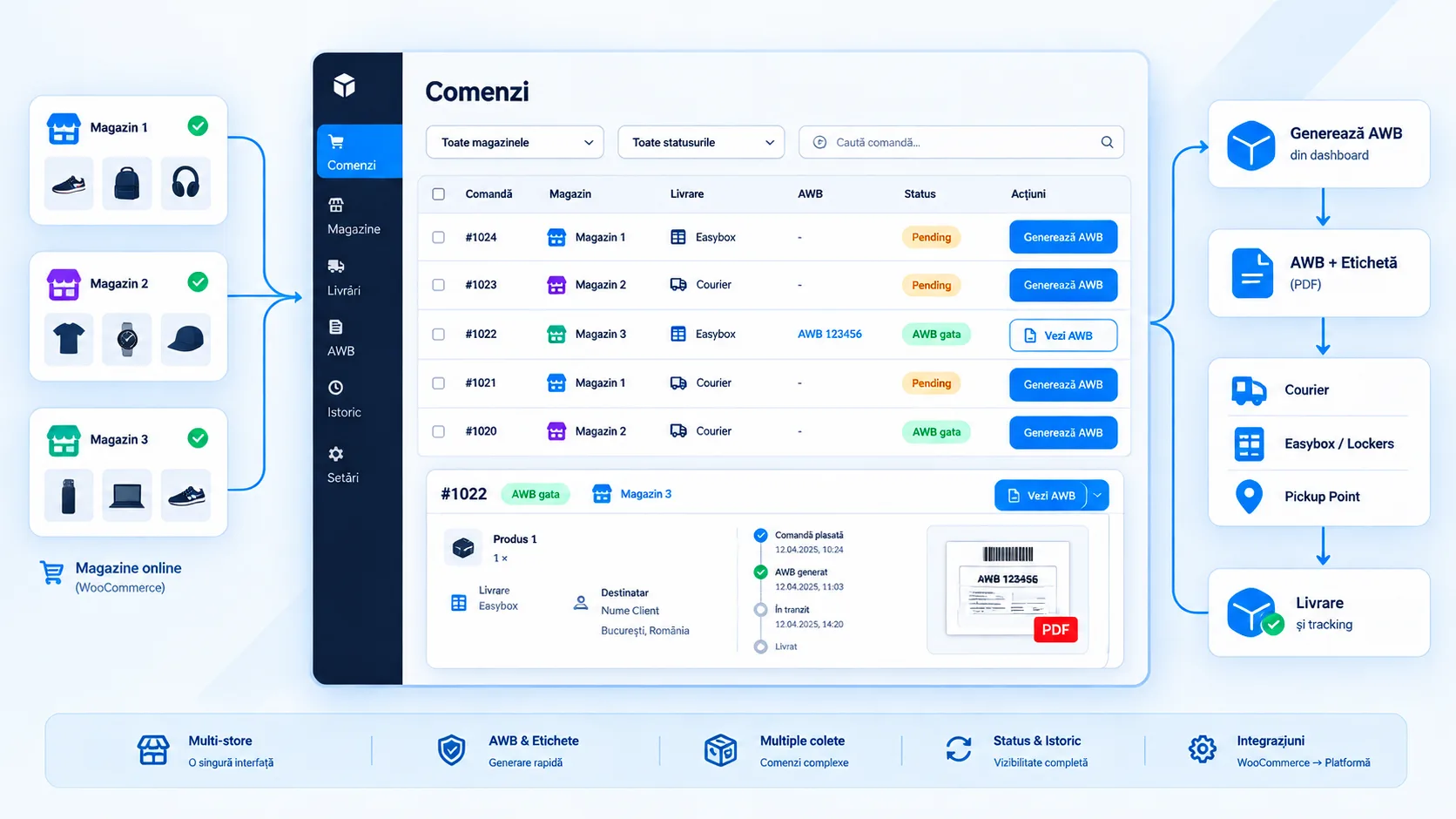
Core stack
The challenge
The challenge was centralizing delivery operations across multiple stores without moving the source of truth away from WooCommerce and without reimplementing the entire courier integration. The solution had to preserve each store's specific settings and data, reduce the operator's manual steps, and define a clear boundary between the central dashboard and the responsibilities of the local plugin.
The solution
The proposed architecture uses a read-only central panel that receives order summaries and sends only the AWB-generation command to the source store. A custom WordPress endpoint was meant to authenticate the request with HMAC and a timestamp, re-read WC_Order and local settings, and reuse the Sameday plugin/SDK for the AWB. This way, the complex integration with services, lockers, pickup points, PDF, and tracking stays in the already-existing component, while the central application focuses on aggregation and operations.
Notable complexity
The project was designed for an operator running multiple WooCommerce stores who was losing time logging separately into each wp-admin to check orders and generate shipping documents. The direction defined in the repository is a read-only central application: orders are aggregated into a single dashboard, and the main action is "Generate AWB." The order remains the source of truth in WooCommerce, so addresses, payment method, and delivery options are not edited in the central application.
The proposed architecture avoids duplicating the courier API. Each store keeps the official Sameday Courier plugin, which already knows how to authenticate the account, sync services, pickup points, lockers/easybox, estimate cost, generate and delete AWBs, produce the PDF, add parcels, and read the status history. The central application was meant to send only the order identifier to the store through a custom WordPress endpoint; the source plugin/site would rebuild the payload from WC_Order and local metadata, then execute the AWB operation within the store's own context.
The repository contains two original design deliverables: a technical specification and an HTML presentation for the limited-budget variant. They describe a full flow from order to AWB, the proposed Site, Order, and Awb models, an OrderIngestService for webhook or periodic pull, an AwbService, and a simple retry policy. Authentication between the central application and WordPress is documented using HMAC-SHA256, a timestamp, and a separate key per site, with rollout planned first on a pilot store and then replicated.
Important for evaluating this portfolio entry: the central Laravel + Vue/Inertia application, the custom REST endpoint, the HMAC, the ingest webhook/pull, and the retry logic are not present as implementation in the saved code. The file list in the backup commit contains the HTML prototype, the documentation, and the official Sameday plugin — not Laravel models, migrations, controllers, Vue components, or workflows for a central application. For this reason, the project is presented as an integration solution designed for a real client, not as a delivered final product.
The analyzed third-party base is a mature WordPress/WooCommerce plugin. Its code uses PHP, JavaScript/jQuery, WP_List_Table, MySQL tables through wpdb, and the Sameday PHP SDK. The plugin implements AWB generation with one or more parcels, service and pickup-point selection, locker/easybox selection via list or interactive map, cost estimation, extra fees and free-shipping rules, COD/repayment, open-package, AWB PDF, AWB deletion, and parcel status history. These capabilities explain why the proposed solution reused the plugin instead of duplicating this logic in the central application.
The existing original frontend is a presentation/prototype page, not the final dashboard. It uses Inter and a light-blue palette with semantic green/amber/red accents, cards, a timeline, and sections for scope, flow, deliverables, and risks. The included plugin screenshots show the inherited WordPress UI: a configuration form, a service selector, an AWB-generation modal, and a history table. For the final product, the logical direction was preserving operational clarity in a modern dashboard rather than visually copying wp-admin.
From an operational standpoint, the design explicitly accepted trade-offs for the MVP: a read-only application, a synchronous call to WordPress, no queue, basic logging, and no advanced monitoring. These limits reduce cost and risk in the pilot phase, but they mean bulk operations, idempotency, locking, rate limiting, periodic reconciliation, and observability would have needed to be defined before higher-volume use. The inherited plugin has its own administrator/shop_manager role checks and nonces for sensitive operations, but the documented custom endpoint cannot be considered secure until the HMAC, anti-replay, and per-site/per-order authorization are implemented and tested.
Key results
- Technical specification for a multi-store flow: WooCommerce → central panel → WordPress → AWB generation
- HTML presentation prototype of the MVP variant, with scope, end-to-end flow, deliverables, limitations, and rollout steps
- Explicit separation of the read-only central application from the WooCommerce source of truth
- Plan to reuse the official courier plugin instead of duplicating the API and mappings in the central backend
- Proposed data model for Site, Order, and Awb, and proposed services for ingest and AWB generation
- Proposed security design with HMAC-SHA256, an anti-replay timestamp, and a separate key per store
- Inventory of the existing plugin's capabilities: services, pickup points, lockers/easybox, AWB, PDF, parcels, and status history
- Definition of MVP limitations: no central order editing, no queue, and a synchronous call to the source store
Related projects
- DeltaPlus ERP IntegrationLaravel B2B portal connected to the ManFin ERP for catalog and locality synchronization, per-client differentiated pricing, XML/CSV/JSON feeds, online ordering, and asynchronous order export back into the ERP.
- Farmadati Laravel APIIntegration backend that pulls Farmadati nomenclatures via SOAP, downloads paginated datasets, streams XML parsing, normalizes the schema, and persists products, manufacturers, descriptions, and image metadata for API consumption.
- Avanticart → WooCommerce MigrationTechnical discovery for migrating an Avanticart store to WooCommerce: inventorying the data model, mapping products and variations, analyzing prices and relationships, and PHP utilities for verifying CDN images.
Want something similar?
Start with the estimate wizard — answer a few questions and get a realistic price range and timeline.