Avanticart → WooCommerce Migration
Technical discovery for migrating an Avanticart store to WooCommerce: inventorying the data model, mapping products and variations, analyzing prices and relationships, and PHP utilities for verifying CDN images.
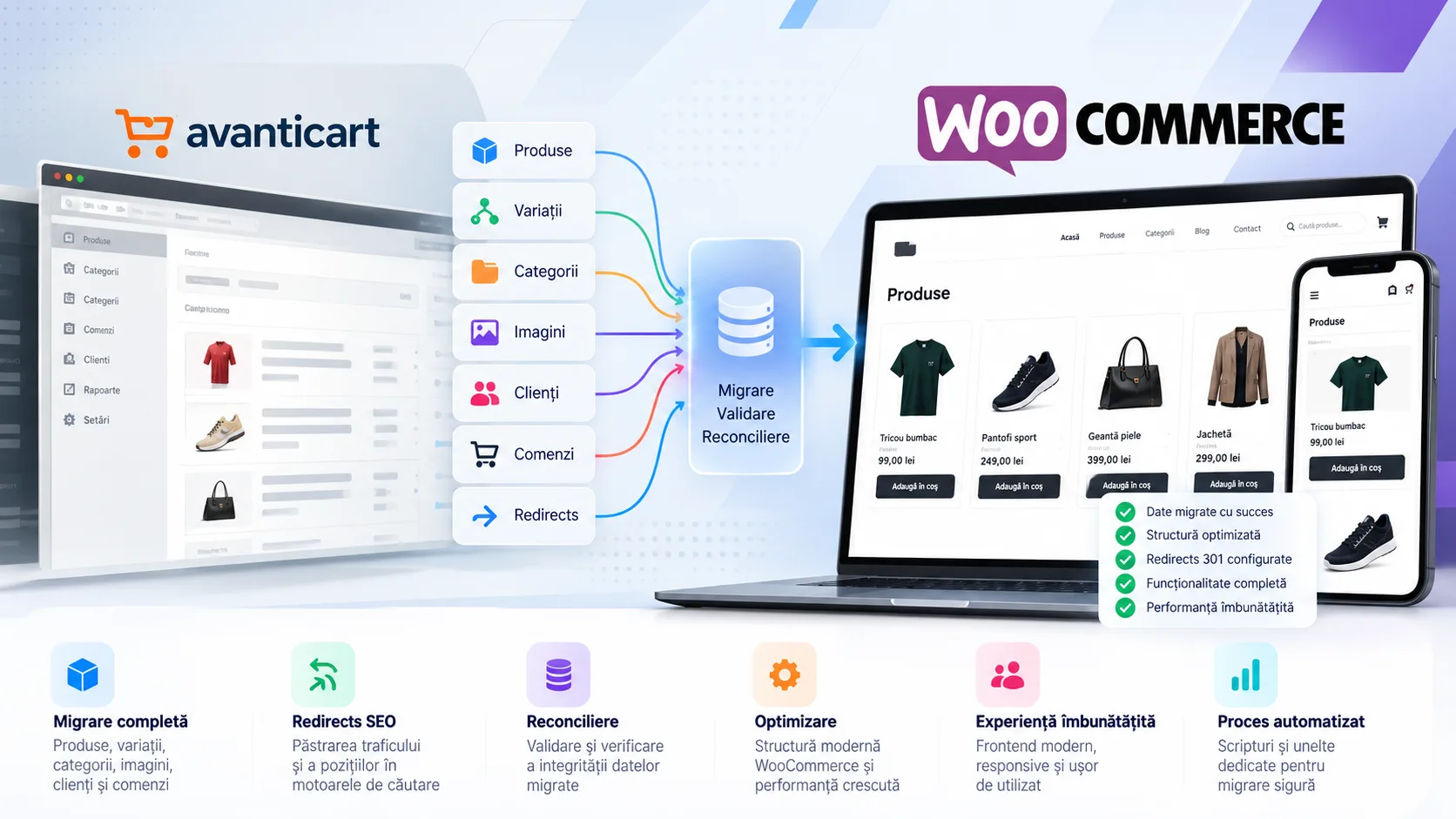
Core stack
The challenge
The challenge was understanding a legacy Avanticart model with many relationships and turning it into a coherent migration plan toward WooCommerce, without losing the semantics between parent products and variations, prices, attributes, categories, and images. Media had an additional difficulty: the database kept identifiers and metadata, while the files had to be reconstructed through a CDN pattern and inherited by variations when they had no images of their own.
The solution
The solution combined analysis of the database structure and relationships with two PHP verification utilities. The documentation defines the Avanticart → WooCommerce mapping and the order of import stages, and the tooling queries the legacy catalog, tests the CDN patterns, and offers a paginated viewer for products and galleries. For variations without their own media, the viewer collects parent IDs and loads the parents' images in a bulk query, then flags them separately in the interface.
Notable complexity
The project captures the analysis and preparation stage of a real migration from Avanticart to WooCommerce. The documented snapshot of the source database includes a catalog with parent products and variations, regular/sale prices, hierarchical categories, manufacturers, attributes, customers, addresses, orders, status history, and reviews. The repository kept for the portfolio does not include the SQL dumps, so these volumes are the ones documented in the analysis performed on the backup, not values recalculated from the repository.
The core of the work is the semantic mapping between the Avanticart model and the WooCommerce target. Parent products and variations are separated via product_parent_id, size and color are identified as candidate attributes for variations, other attributes remain product metadata, and manufacturers are mapped to a brand taxonomy. The analysis also tracks public prices, stock, SKUs, multiple categories, descriptions, and SEO slugs, so that the proposed import order respects the dependencies between the data.
An area that required separate investigation was media. Avanticart kept image references in the database, while the files were served from a CDN. A PHP script tests URL formats on a subset of images, and a second utility offers a web inspection interface with pagination and filters. It groups images by product and, for variations without their own images, makes a second bulk query for the needed parents and attaches the parent's gallery. The pattern documented and used in the viewer is based on seo_name, picture_id, and the "-2.webp" CDN suffix.
The viewer is an internal tool, not a store frontend: server-rendered PHP, inline HTML/CSS, and a bit of JavaScript for flagging images that fail to load. Filters are GET, the page is explicitly cast to an integer, and the main text output is escaped with htmlspecialchars. On the other hand, there is no authentication, observability, retry/backoff, or a service layer; DB connection errors are displayed directly, and the image URL includes data coming from the legacy database without explicit HTML escaping.
From a performance standpoint, the code avoids an obvious N+1 for image inheritance: parent IDs are collected and parent images are loaded in a single IN query. However, the main query applies LIMIT/OFFSET over the product-image join rather than over the list of distinct products. As a result, the number of cards per page can vary, and a product's gallery can be split across pages. A production implementation would first paginate the product IDs, then load the relationships for that set.
The documentation proposes the next phases — configuring WooCommerce, importing master data, products, media, variations, and optionally customers/orders, plus reviews — but the analyzed repository contains no final import scripts, jobs, automatic reconciliation, redirects, or deployment. For this reason, the project is presented as a technical analysis and validation prototype that reduces the risk of a complex migration, not as a completed migration.
Key results
- Inventorying and documenting the main domains in the Avanticart database: products, prices, images, attributes, categories, manufacturers, customers, addresses, orders, and reviews
- Explicit separation of parent products from variations via product_parent_id and defining the mapping to WooCommerce variable products
- Mapping for current price, old price, stock, SKU, categories, and attributes to the WooCommerce target structure
- Identifying the CDN pattern used by the viewer for product images
- PHP utility for testing image URLs from the Avanticart database
- Internal web viewer for inspecting products and images, with pagination and filters for status and media existence
- Fallback for variations without their own images by loading the parent product's images
- Batch query for the needed parents' images, avoiding a separate query per variation
- Staged migration plan starting from master data and continuing with products, media, variations, and optional historical data
- Identifying legacy password incompatibility as a point requiring a reset flow if customer migration is implemented
Related projects
- DeltaPlus ERP IntegrationLaravel B2B portal connected to the ManFin ERP for catalog and locality synchronization, per-client differentiated pricing, XML/CSV/JSON feeds, online ordering, and asynchronous order export back into the ERP.
- Farmadati Laravel APIIntegration backend that pulls Farmadati nomenclatures via SOAP, downloads paginated datasets, streams XML parsing, normalizes the schema, and persists products, manufacturers, descriptions, and image metadata for API consumption.
- Sameday Orders PlatformTechnical concept for centralizing orders from multiple WooCommerce stores and triggering AWB generation from a single panel, reusing each store's existing courier integration instead of rebuilding it in the central backend.
Want something similar?
Start with the estimate wizard — answer a few questions and get a realistic price range and timeline.