Camin Felix Donations Software
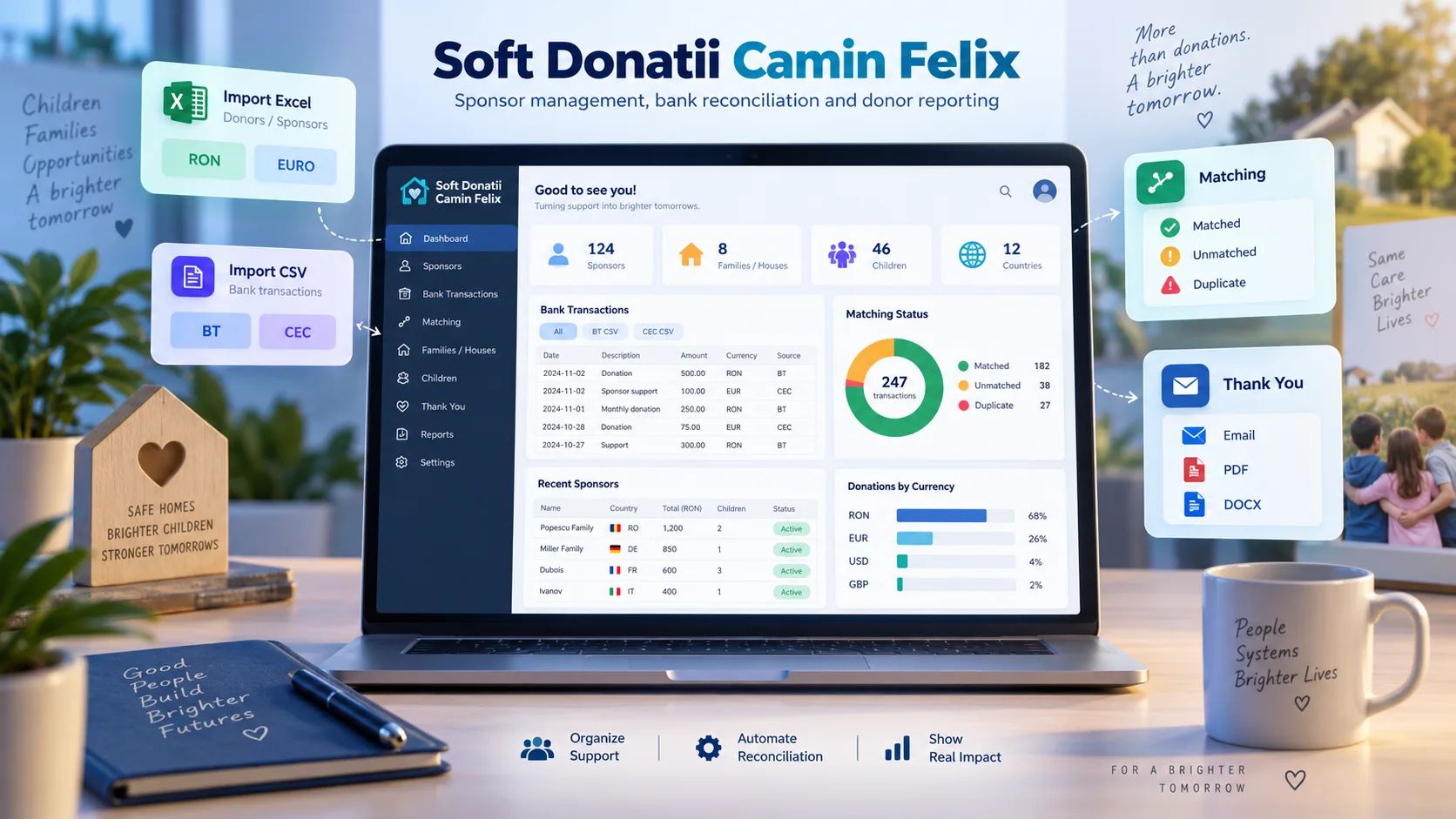
A back office for managing sponsors and donations, with Excel imports and BT/CEC bank statements, transaction matching and deduplication, manual reconciliation, statistics, and thank-you communications via email, PDF, and Word.
Core stack
The challenge
The challenge was turning heterogeneous operational sources — Excel files used as internal records and BT and CEC bank exports with different structures — into a coherent model of sponsors and transactions. The system had to recognize the same donor despite diacritics, different name ordering, or payment intermediaries, avoid re-importing transactions, correctly preserve each donation's currency, and provide a human-verification step for cases where automatic matching is not certain.
The solution
The solution uses a Laravel 12 monolith with Livewire 3 and Blade, so validation, import rules, matching, and persistence stay server-side, while tables and forms remain reactive without a separate SPA. Bank imports have distinct parsers for BT and CEC and are normalized into a common structure before matching. Matching combines name normalization, order-independent tokens, the transaction description, and matching history, while the unique database reference complements the duplicate check in the preview. Eloquent models sponsors, families, children, countries, currencies, and transactions, and TCPDF, PHPWord, and Laravel Mail automate thank-you communications for digital and printed channels.
Notable complexity
Camin Felix Donations Software centralizes an organization's internal activity around sponsors and donations. Sponsors are managed together with contact details, country, usual currency, associated family or house, sponsored children, active status, and the operational GDPR indicator. Historical data can be imported from separate Excel files for RON and EURO, and the process even honors existing conventions from the organization's documents: cell formatting is used to identify inactive sponsors and GDPR-flagged records.
The main flow processes CSV bank statements from Banca Transilvania and CEC Bank. For BT, the app locates the actual header of the export, reconstructs CSV rows that may contain commas within descriptions, normalizes amounts in local formats such as 1,234.56 or 1.234,56, keeps only incoming payments, and can detect RON or EUR currency from the statement. For CEC there is a separate parser that filters out fees, interest, currency exchanges, and internal transfers, and extracts the payer from the bank's text fields. Before saving, the user gets a preview with matched, unmatched, and duplicate transactions.
Sponsor matching is built as a deterministic pipeline. Names are normalized by removing diacritics and special characters, then compared exactly or as a token set for cases where the name order differs. If direct matching fails, the app searches for the name within the description and uses the history of already-matched transactions. For known intermediaries, such as postal services or organizations through which payment may arrive, matching uses significant terms from the description and historical associations. Bank references are checked in batch and further protected by a unique index in the database, and the operator can manually match, unmatch, or correct transactions that remain ambiguous.
The dashboard and reports track active sponsors, records without GDPR, donations by currency, unallocated transactions, and aggregates across sponsors, families, children, and countries. For donor relations, the app builds a thank-you report filterable by period, country, and family. Donors with an email can be sent messages individually or in bulk, and for those without email, personalized letters and envelopes are generated in PDF or DOCX, individually or into a ZIP archive for printing. A separate Artisan command allows reconciling BT amounts by bank reference in dry-run mode and applying corrections in a controlled way.
Key results
- Unified records for sponsors, families, sponsored children, countries, currencies, and GDPR operational status
- Sponsor import from RON/EURO Excel registers, including interpreting the formatting conventions used in existing files
- Transaction import from the current Banca Transilvania and CEC Bank CSV exports
- Normalization of bank amounts with thousand and decimal separators in Romanian and international formats
- Pre-save preview separating matched, unmatched, and duplicate transactions
- Automatic matching on normalized name, tokens, description, and matching history
- Separate handling of payment intermediaries, using information from the transaction description
- Deduplication by bank reference and a unique database-level constraint
- BT reconciliation via an Artisan command with dry-run by default and explicit application of corrections
- Manual correction of match, currency, amount, description, date, and transaction reference
- Operational dashboard and reports on sponsors, families, children, countries, currencies, and unallocated transactions
- Thank-you messages via email and PDF/DOCX documents for donors without an email address
- Individual or bulk document generation for printing and ZIP archiving
Related projects
- GrileAMGA training ecosystem for nursing assistants: courses, multiple-choice questions, exam simulations, statistics, and tests distributed by teachers, across web, iOS, and Android, with subscriptions, AI, and editorial administration.
- Risa TimeA digital ecosystem for picking up a customer's car, transporting it to a partner car wash, and returning it safely, coordinated through separate customer and driver apps, an operations panel, and real-time tracking.
- MixboxA multi-vendor marketplace for local products, with a single cart spanning multiple stores, separate apps for customer, merchant, and courier, flexible payments, and an advanced system for importing and managing supplier catalogs.
Want something similar?
Start with the estimate wizard — answer a few questions and get a realistic price range and timeline.