Mixbox
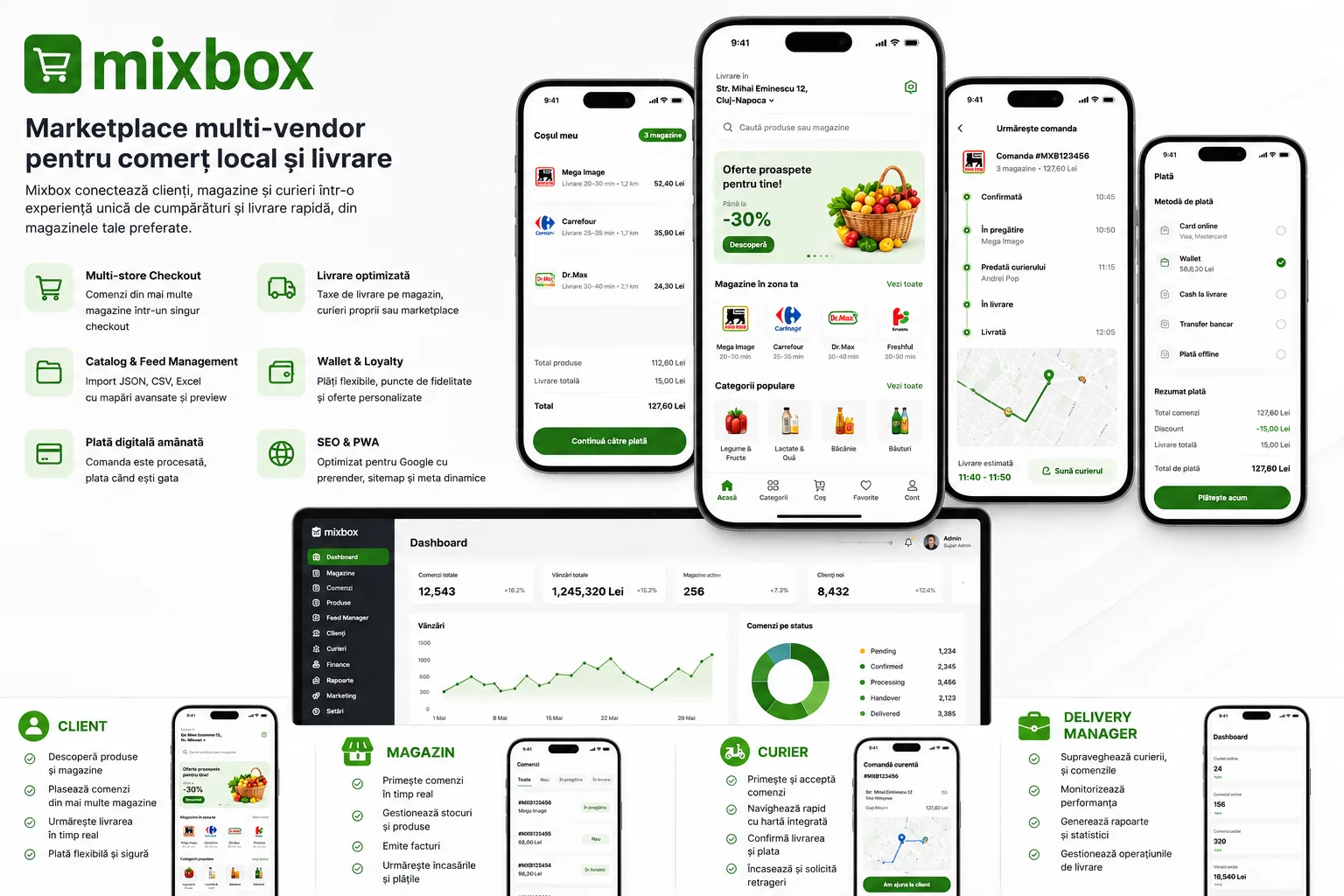
A multi-vendor marketplace for local products, with a single cart spanning multiple stores, separate apps for customer, merchant, and courier, flexible payments, and an advanced system for importing and managing supplier catalogs.
Core stack
The challenge
Adapting a general multi-vendor base to Mixbox's operations required coordinating four codebases and several mutually interdependent flows: a cart with products from multiple stores, separate delivery calculation, a single payment experience, isolated visibility for each merchant, statuses synchronized with the courier, and a catalog fed by heterogeneous feeds. At catalog scale, a naive approach with queries and saves for every field of every product would have produced long processing times, high memory usage, and inconsistent taxonomies. At the same time, digital payment had to be requestable only after the store confirmed processing, without resetting the order's progress.
The solution
Laravel 10 and a relational database centralize identity, authorization, catalog, orders, payments, delivery, and business rules into a shared API for the three Flutter apps. Multi-store checkout groups the cart server-side and reuses the validated order flow for each store, adding OrderGroup for consolidated digital payment. Imports use batches of 200 products, cache warm-up, preloading products and logs, buffers for inserts and relations, persistent progress and resuming, and products that disappear from a feed are pulled from stock without affecting manually added products. A central resolver keeps the same taxonomy across preview, JSON, CSV/Excel, and the Feed Category Manager. GetX separates controllers, services, and repositories from the UI in the Flutter apps; Firebase, maps, and geospatial APIs synchronize notifications and delivery, and GitHub Actions automates builds and publishing to the existing web infrastructure.
Notable complexity
Mixbox coordinates customers, stores, couriers, delivery managers, and administrators into a single product. The customer uses a Flutter app available on mobile and web for location, discovering stores and products, favorites, cart, checkout, payments, order tracking, history, reviews, and support. The store gets its own Flutter app for orders, statuses, catalog, stock, coupons, schedule, invoices, receipts, and POS operations, and the courier has a separate app for availability, delivery requests, acceptance, navigation, location, payment proofs, cash collection, wallet, and history. The Laravel backend serves all of these experiences and includes the shared API, the admin panel, and the interface dedicated to the delivery manager.
The product starts from the SixAMart commercial base, but the Mixbox code adds and extends flows that substantially change the standard behavior. Checkout allows products from multiple stores in the same cart: the backend groups line items by store, validates each store separately, and creates distinct orders, with distance and delivery fee calculated per store, coupons distributed proportionally, and split tips controlled across deliveries. For multi-store digital payment, an OrderGroup is created that allows consolidated payment of the resulting orders, without each store seeing or operating on the others' products.
A major component is managing catalogs sourced from suppliers. Mixbox accepts JSON, CSV, XLS, and XLSX feeds, manual or scheduled import, preview, column normalization, batch processing, resuming from the last processed index, import logs, and updating existing products by SKU. The CategoryResolverService centralizes the same rule for both preview and import: explicit SKU mapping takes priority, followed by source-taxonomy mapping, direct matching, and, in the absence of a valid resolution, sending the product to the Uncategorized area for review. The Feed Category Manager allows simple or compound mappings, creating categories, moving existing products, ignoring sources, and synchronizing images. The implemented SKU mapping is a feed-specific or general classification rule; it is not presented in the portfolio as an automatic cross-supplier stock consolidation system, since the current code does not demonstrate that mechanism.
Orders go through operational states common to the apps: pending, confirmed, accepted, processing, handover, picked_up, and delivered, with branches for cancellation, failure, and refund. The backend checks the geospatial zone, the store's schedule and availability, quantity limits, variations, stock, coupons, fees, delivery costs, vehicle, and payment-method restrictions before saving. Stock is updated in the same transaction as the order details for an individual order, and cancellation restores the quantities. Couriers can be assigned or can accept requests, transmit their location, update statuses, confirm payment, and can upload proofs; the customer and the store receive updates via Firebase and persistent notifications.
Payments confirmed in the code include cash on delivery, digital payment, wallet, offline payment, bank transfer, and partial payment from the wallet. The deferred digital-payment flow allows creating the order as unpaid, showing it to the store immediately, and sending the payment request to the customer when the store moves the order into processing. After payment, the operational status is preserved and the store is notified. For digital orders spanning multiple stores, OrderGroup centralizes the amount and payment status.
On web, the Flutter app dynamically sets title, description, canonical URL, and Open Graph/Twitter metadata for products, stores, categories, and brands. The backend fills in the limitations of a client-rendered app with pre-rendered pages for crawlers, robots.txt, and a cached dynamic sitemap for public slugs. Technical delivery is split across four GitHub Actions workflows: SSH deploy of the backend on push to main, build and deploy for customer web plus APK, and APK build/distribution for the store and courier apps. The current workflows automate the build and distribution to the server, but are not presented as automatic App Store or Google Play publishing, and they do not include a test suite or automatic rollback.
Key results
- 4 coordinated codebases: Laravel backend and admin, Flutter customer app, Flutter store app, and Flutter courier app
- 5 operational actor families confirmed in the code: customer, store/vendor, courier, delivery manager, and administrator
- Multi-store checkout that turns a single cart into isolated per-store orders, with distance, delivery, coupons, and tips explicitly calculated or distributed
- Consolidated digital payment via OrderGroup for orders spanning multiple stores
- 6 confirmed payment mechanisms: cash on delivery, digital payment, wallet, offline payment, bank transfer, and partial payment
- Deferred digital-payment flow, requested when the store moves the order into processing, preserving the operational status after confirmation
- 4 processed catalog formats: JSON, CSV, XLS, and XLSX, via manual or scheduled import
- Imports processed in batches configured at 200 products, with persistent progress, resuming from the last index, and marking zero stock for SKUs missing from the feed
- Single category resolver used by JSON, CSV/Excel imports, preview, and the Feed Category Manager, with priority SKU mapping → category mapping → direct match → Uncategorized
- Feed Category Manager for simple and compound mappings, category creation, updating existing products, controlled skipping, and image synchronization
- 7 main operational states synchronized between the backend and the apps, plus cancellation, failure, and refund flows
- Web SEO for products, stores, categories, and brands: slugs, canonical URLs, Open Graph, Twitter metadata, crawler prerender, robots.txt, and a cached dynamic sitemap
- Push notifications via Firebase, persistent in-app notifications, and emails conditioned on the event type
- 4 GitHub Actions workflows for backend deploy, customer web deploy, and distributing the three APKs to the server
Related projects
- GrileAMGA training ecosystem for nursing assistants: courses, multiple-choice questions, exam simulations, statistics, and tests distributed by teachers, across web, iOS, and Android, with subscriptions, AI, and editorial administration.
- Risa TimeA digital ecosystem for picking up a customer's car, transporting it to a partner car wash, and returning it safely, coordinated through separate customer and driver apps, an operations panel, and real-time tracking.
- YouSpaceA platform that helps families find the right specialists for children and teenagers, and lets professionals publish their profile, articles, and events within an ecosystem featuring verification, subscriptions, and centralized administration.
Want something similar?
Start with the estimate wizard — answer a few questions and get a realistic price range and timeline.