Events & Ticketing Portal
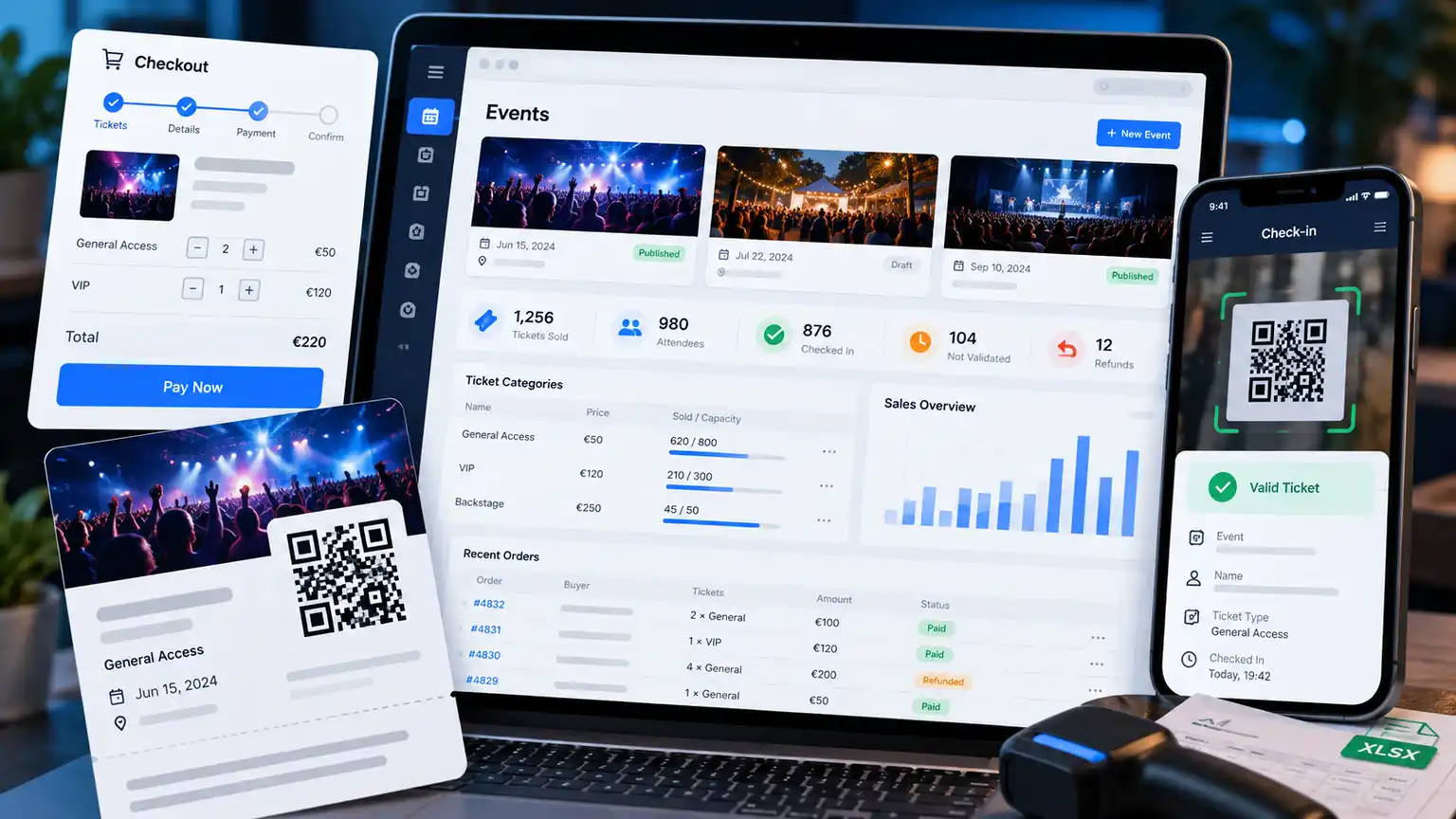
Event ticketing platform built on a custom PHP MVC framework, with ticket categories, checkout and payments, QR issuance, access validation, refunds, and operational reporting.
Core stack
The challenge
The challenge was building a coherent ticketing flow on top of a custom PHP MVC framework: capacity and ticket categories had to stay synchronized with checkout and payment, and after issuance the QR code had to be validated only once at entry. At the same time, organizers needed visibility into sales, attendees, and financial operations without splitting the logic across separate systems.
The solution
The documented solution uses a custom PHP MVC framework, MySQL and PDO with prepared statements, session-based authentication and CSRF, plus unique tokens attached to QR tickets. Validation marks the token as used to prevent double scanning, and the organizer dashboard centralizes sales, ticket status, and reports. Excel export and email delivery of tickets round out the operational flow, and the project scope includes checkout, payments, and refunds without attributing an unverified provider.
Notable complexity
Events & Ticketing Portal is a client project built around the full lifecycle of a ticket-gated event: event and capacity configuration, ticket category definition, checkout, payment, ticket issuance, entry validation, and downstream operations such as refunds and reporting.
The legacy documentation kept in the Tigidal portfolio describes the application as having been built before Laravel was adopted, on a custom PHP MVC framework under the hthepaul/ namespace. The documented architecture includes routing with URL parameters, PHP layouts and partials, MySQL access through PDO with a simplified query/ORM layer, session-based authentication, and CSRF protection. The same documentation points to a classic HTML/CSS/JavaScript frontend, Bootstrap, and jQuery.
The ticketing flow allows organizing multiple events and configuring multiple ticket categories, each with its own price, quantity, and sales window. After checkout and payment confirmation, the ticket is issued with a unique QR code and can be emailed to the buyer. For access control, scanning the QR verifies the ticket token and marks it as used, so the same entry cannot be validated repeatedly.
The documented operational area includes distinct roles for administration, organizing, and validation, dashboards with sales and ticket status, Excel export of attendees, and transaction modules. Legacy frontend data also mentions payouts, coupons, social, and notifications in the broader product structure. The current scope provided for the project additionally confirms capacity, refunds, and reporting as important parts of the flow.
Because the original HthePaul/alex repository is not available in the GitHub installation connected in this session, these architectural details are presented as historical documentation kept within Tigidal, not as a line-by-line revalidation of the current source code. No specific payment provider, deployment, or other integrations beyond what appears in the available materials are attributed to the project.
Key results
- Documented ticketing platform for managing multiple events and ticket categories
- Custom PHP MVC framework with routing, templating, and data access through PDO
- Checkout and payments integrated into the ticket purchase flow
- Unique QR code generation for every issued ticket
- QR validation at entry with a one-time mechanism to prevent duplicate scans
- Emailing tickets to buyers
- Organizer dashboard with sales and ticket status
- Operational reports and Excel export of the attendee list
- Refund flow included in the project's functional scope
Related projects
- GrileAMGA training ecosystem for nursing assistants: courses, multiple-choice questions, exam simulations, statistics, and tests distributed by teachers, across web, iOS, and Android, with subscriptions, AI, and editorial administration.
- Risa TimeA digital ecosystem for picking up a customer's car, transporting it to a partner car wash, and returning it safely, coordinated through separate customer and driver apps, an operations panel, and real-time tracking.
- MixboxA multi-vendor marketplace for local products, with a single cart spanning multiple stores, separate apps for customer, merchant, and courier, flexible payments, and an advanced system for importing and managing supplier catalogs.
Want something similar?
Start with the estimate wizard — answer a few questions and get a realistic price range and timeline.