Autoservice App
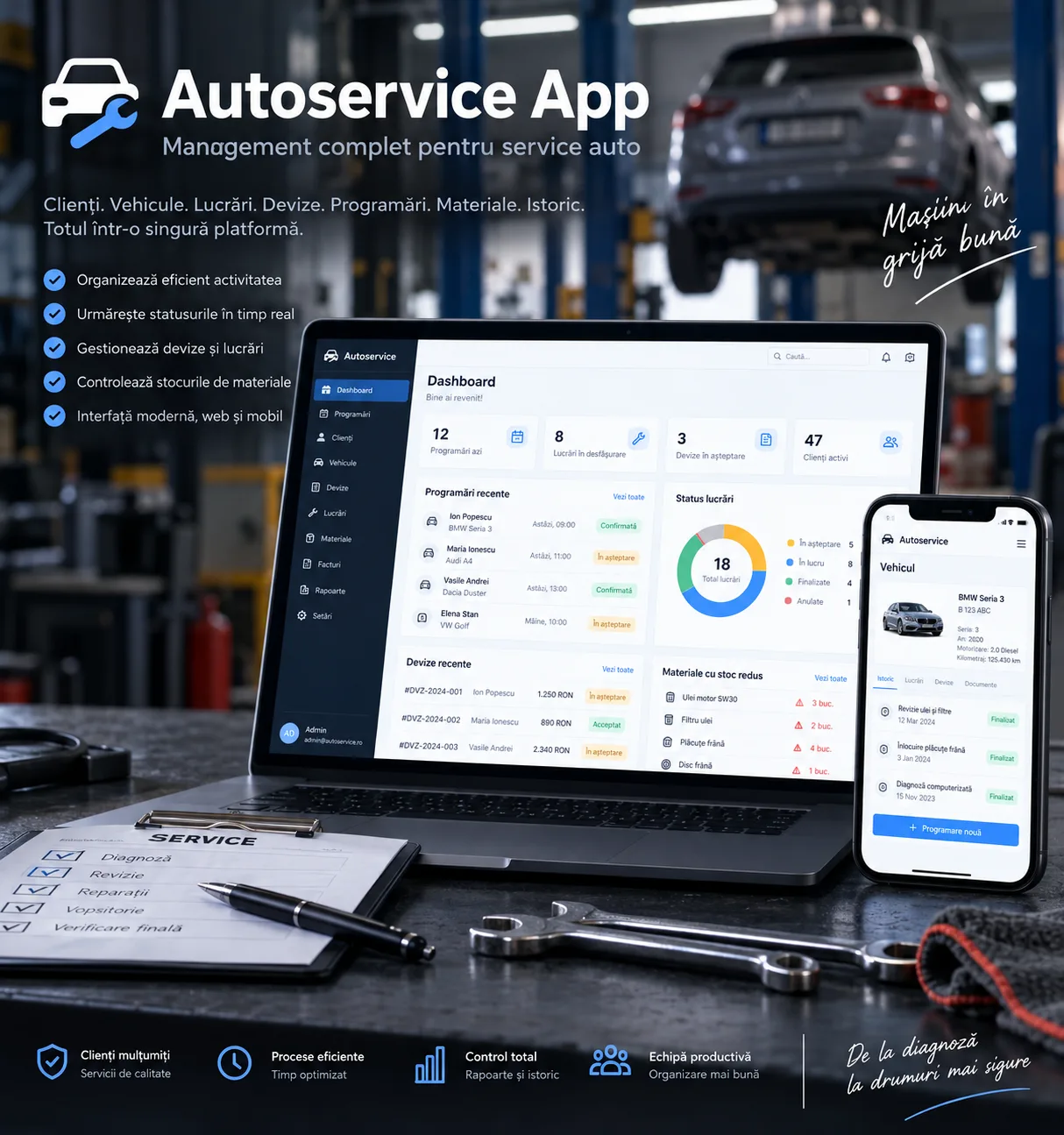
An operational application for centralizing customers, vehicles, appointments, service orders, work items, RCA/CASCO insurance files, documents, invoices, payments, and reimbursements.
Core stack
The challenge
The main challenge was coherently modeling two processes that constantly intersect in an auto shop: the appointment → order → work → invoicing → handover cycle, and the RCA/CASCO cycle from opening the claim file through approval, repair, and reimbursement. Data has to be linked across customer, vehicle, order, documents, and file, and sensitive transitions — handover, estimate reapproval, and closing the file — have to enforce clear operational rules.
The solution
The solution uses a modular React/TypeScript application with React Router for the operational surfaces and a KV layer over localStorage for the demo version's persistence. TypeScript models describe the relationships between customers, vehicles, appointments, orders, work lines, files, estimates, supplements, documents, invoices, reimbursements, timeline, and audit. The interface applies validations and business rules within the relevant modules, restricts visibility and actions based on role, and offers contextual navigation and search across entities. For a deployment with real data, the project's documentation explicitly separates out the need to move authentication, authorization, persistence, and files into an authoritative backend.
Notable complexity
Autoservice App brings the daily workflows of an auto shop into a single interface: customer and vehicle records, appointments, intake sheets, work orders, labor and parts, documents, insurance claim files, invoicing, payments, reimbursements, and reporting. Navigation links entities together, so a customer can be traced to their vehicles, orders, claim files, and documents, and a confirmed appointment can be converted directly into a service order.
The service flow uses statuses from a new order through to vehicle handover, priority, mileage, findings, and work lines for services, labor, parts, and consumables. Line costs include quantity, unit price, discount, and VAT, and estimated versus actual time can be tracked separately. The handover rule prevents moving an order to "Handed over" before it has reached a finalized or invoiced state.
The RCA/CASCO module models the insurance claim file separately from the service order. It keeps the insurer, the policy, the incident data, the inspector, the financial values, and a detailed operational status. The claim number is checked for uniqueness per insurer, and closing can be blocked if the estimate, the findings, or the invoice are missing, or if there is an unresolved balance. Estimates are versioned, and a new version created after an existing approval automatically enters the "requires reapproval" state. Supplements and a timeline complete the file's operational history.
Documents can be uploaded in bulk for a customer, vehicle, order, or file, with type, notes, author, timestamp, and versioning for estimates and findings. The interface validates PDF/JPG/PNG/DOCX extensions and a 20 MB limit, then keeps the file as a Data URL in the browser. Invoices and payments calculate the unpaid/partial/paid status, and reimbursements for claim files track requested, approved, and paid amounts. Global search and contextual filters link the modules together, and reports aggregate operational, RCA/CASCO, and financial indicators and allow CSV export.
The analyzed version is built as a React 19 + TypeScript + Vite SPA, with local persistence through a KV layer over Web Storage. Demo data is generated per domain and re-seeded in a controlled way via a dataset version. Four roles — administrator, front desk, technician, and accounting — control the visibility of modules and certain actions, including costs and document types. However, these permissions and the authentication are exclusively client-side in the current repository: the demo password is not verified, and localStorage does not represent a security barrier for real data.
The Git history shows that the project started from a prototype generated with GitHub Spark and was later extended with per-module data generators, contextual navigation, document flows, role-based access rules, action auditing, and global search. The repository's documentation separately defines the contract and direction for a future server-side backend; that backend is not present in the analyzed code and is not claimed as an implemented result.
Key results
- Unified interface for customers, vehicles, appointments, service orders, RCA/CASCO files, documents, invoices, reports, and settings
- Four operational roles with differentiated access to modules and actions: administrator, front desk, technician, and accounting
- Direct conversion of a confirmed appointment into a service order linked to the same customer and vehicle
- Work orders with status, priority, mileage, findings, and separate lines for services, labor, parts, and consumables
- Business rule blocking handover of an order before it is finalized or invoiced
- RCA/CASCO files with operational statuses, financial values, inspector, policy, and uniqueness verification of the claim number per insurer
- Versioned estimates that require reapproval when a new version appears after an existing approval
- Configurable blocking of file closure when required documents are missing or a balance remains unresolved
- Multiple document upload in PDF, JPG, PNG, and DOCX for a customer, vehicle, order, or file, with metadata and versioning where relevant
- Invoices, payment recording, and reimbursements for claim files with statuses calculated from the persisted values
- Local audit for create, edit, delete, and critical operations across the main modules
- Global search and contextual navigation between associated entities
- Operational, RCA/CASCO, and financial reports filterable by period, with CSV export
- Per-module generated demo dataset, versioned for consistent app initialization
Related projects
- CreativeSys AutoA custom online store with simple and variable products, a dynamic catalog and filters, checkout, EuPlătesc payments, commercial documents, full administration, and a separate quoting flow for car paint.
- Ghici Cine (Guess Who)A multiplayer browser party game with private rooms, words submitted by participants, real-time synchronized turns, per-player filtered state, and reconnection to the active session.
- Vedete & Inițiale (Celebrities & Initials)A multiplayer web app for TOMAPAN (categories/initial-letter) rounds in private rooms, with an access code, configurable categories, a shared letter, a timer, scoring for unique or duplicate answers, and real-time synchronization between players.
Want something similar?
Start with the estimate wizard — answer a few questions and get a realistic price range and timeline.