BTSO
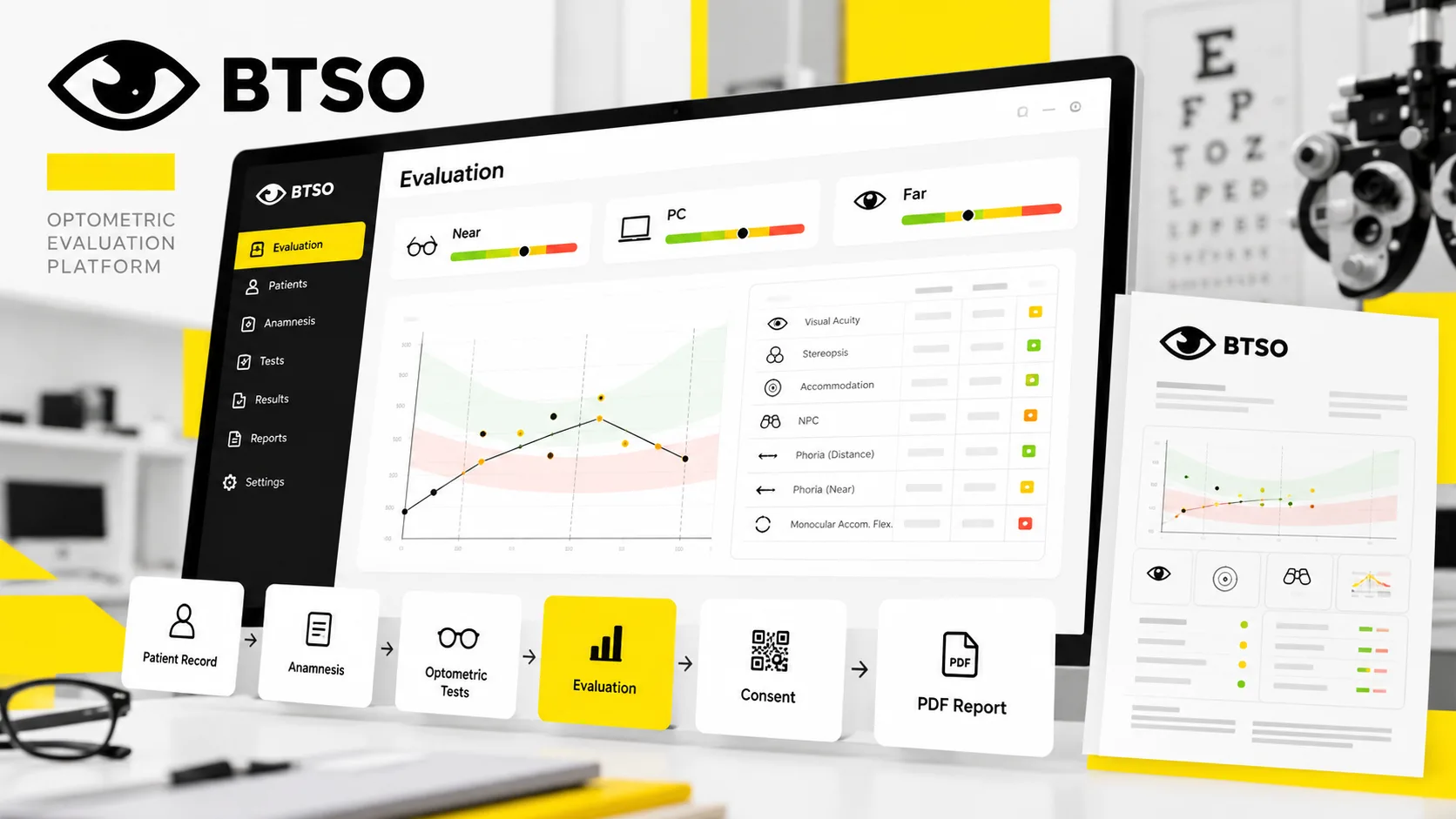
Vue 3 + Laravel platform for patients, anamnesis, configurable optometric tests, scoring, visual evaluation, documented consent, and PDF reports, in a multi-company model with roles and localization.
Core stack
The challenge
The challenge was extending an existing clinical product in which each evaluation combines sensitive data, conditional questions, configurable methods, method-dependent properties, clinical formulas and thresholds, a customized test order, contextual documentation, and a coherent final report, with data separation between companies.
The solution
The solution keeps the clinical domain in a relational Laravel model and separates API access, business logic, and persistence through controllers, services, repositories, resources, and policies. Treatments attach the configured questions and tests, methods can regenerate properties within transactions, and the entered values are transformed into Z indicators and evaluation data. The Vue SPA orchestrates the clinical journey through Vuex and Router, and reporting combines the Chart.js chart captured from the frontend with the PDF generated server-side via mPDF.
Notable complexity
BTSO is a B2B web application for organizing and executing an optometric screening and evaluation workflow. The domain links the patient to evaluation sessions (Treatment), anamnesis and strabismus questions, an ordered battery of tests, measurement methods, and measurable properties. The interface offers both a guided step-by-step journey and a fast sequence that concentrates the anamnesis, refraction data, and main tests into a single workspace.
Clinical tests are configured in the database and cover distance visual acuity, stereopsis, accommodation amplitude, near point of convergence, distance/near phoria, and monocular accommodative facility. Methods can change the set of properties attached to a test; the user can save their preferred method and test order, and a new evaluation can reuse baseline optometric data from the previous session.
The final evaluation aggregates much more than the raw answers. The backend computes Z-scores based on the configured formulas, the difference between distance and near phoria, and, for compatible methods, the AC/A ratio. The API builds an anamnesis profile with ok/suspicious/skipped states, prepares the series for the chart, and adds system notes for methods where the values are not treated as evidence-based. The frontend renders the result in a Chart.js chart with normative zones and in a table of measured values.
Reporting is hybrid. The frontend captures the chart visualization and sends it as a PNG, and Laravel/mPDF generates the final report on the server with the patient's data, the optometric parameters for the right and left eye, the evaluation chart, contextual documentation, the input values, and the clinician's observations.
Consent for data processing has a separate flow: the backend generates a PDF template with a QR code linked to the patient's UUID, and the signed document can be uploaded as JPG, PNG, or PDF. The file is normalized with Imagick when needed, the QR code is read and verified against the patient, and the status and the user who processed the document are persisted.
The backend uses Laravel 10 / PHP 8.2, REST controllers, Form Requests, Resources, Services, Repositories, Eloquent, and Policies. Isolation of clinical resources is done by company_id, the main model is Patient → Treatment → TreatmentTest/TreatmentQuestion → Property, and the treatment creation and method-change operations are transactional. MySQL holds the operational data, and a secondary MySQL connection periodically receives a pseudonymized dataset.
The frontend is a Vue 3 SPA in JavaScript, built with Vite, Vue Router, Vuex, Axios, and Tailwind CSS. Authentication uses Laravel Sanctum sessions and a CSRF cookie, with optional email-based 2FA at the company level. The UI includes a patient registry, a collapsible side navigation, screens dedicated to clinical stages, a fast sequence, embedded PDF documentation, user administration, settings, and localization into multiple languages.
Operationally, Laravel Scheduler starts jobs for cleaning up unfinished evaluations, notifying and deleting expired trials, and syncing the pseudonymized dataset. The sync jobs process data in chunks, but the repository's default configuration remains queue=sync unless the environment overrides it.
The Git history clearly shows that the application was not built entirely from scratch in the HthePaul2 repository: the initial commits from 2022 belong to another developer, and there are later merges and migrations from GitLab/FLZSFL. HthePaul2's verifiable contribution in 2024–2025 includes PDF branding updates, fixes in the clinical documentation flowchart, localization of the final report and of classes/methods/properties, as well as an extensive modification of TestEvaluationView aimed at the final evaluation's performance issue.
The snapshot audit also highlights hardening technical debt: legacy web routes for running and displaying anonymization data have no authentication middleware in the analyzed file, logging can capture headers, bodies, SQL queries, and authentication data, and persisted formulas are evaluated via eval. The analyzed repositories contain no GitHub Actions or Docker and only have the example Laravel tests, so securing these areas and introducing a test suite/CI are the natural next steps.
Key results
- Patient → Treatment → anamnesis/strabismus → tests → evaluation → PDF report flow implemented end-to-end
- Six main categories of configurable optometric tests, with associated methods and properties
- Scoring via Z-scores, distance-near phoria difference, and AC/A calculation for compatible methods
- Two working modes: guided clinical sequence and fast test sequence
- Test order and preferred method can be saved per user
- New evaluations can reuse optometric parameters from a previous evaluation
- Server-side PDF report with clinical data, chart, contextual documentation, input values, and observations
- Consent flow with a PDF template, per-patient QR code, upload, and document verification
- Per-company isolation for clinical resources via Laravel Policies
- Sanctum authentication, password reset, and optional email-based 2FA
- Localization into German, English, French, Italian, and Spanish for UI/reporting
- Scheduled jobs for unfinished evaluations, trials, and syncing the pseudonymized dataset
- HthePaul2 contributions verified in Git for the clinical flowchart, translations/labels, PDF branding, and the final evaluation page
Related projects
- CreativeSys AutoA custom online store with simple and variable products, a dynamic catalog and filters, checkout, EuPlătesc payments, commercial documents, full administration, and a separate quoting flow for car paint.
- Ghici Cine (Guess Who)A multiplayer browser party game with private rooms, words submitted by participants, real-time synchronized turns, per-player filtered state, and reconnection to the active session.
- Vedete & Inițiale (Celebrities & Initials)A multiplayer web app for TOMAPAN (categories/initial-letter) rounds in private rooms, with an access code, configurable categories, a shared letter, a timer, scoring for unique or duplicate answers, and real-time synchronization between players.
Want something similar?
Start with the estimate wizard — answer a few questions and get a realistic price range and timeline.